

Experience the future of
Fraud Detection
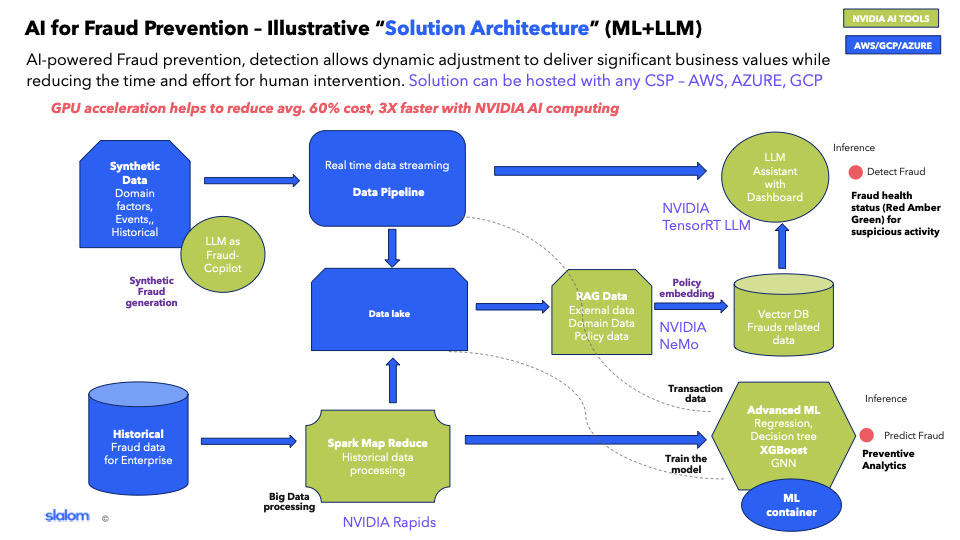
In an era where financial fraud is increasingly sophisticated, your financial services process deserves an equally advanced defense system. Welcome to FriskAI, the pinnacle of innovative technology, combining SOTA machine learning algorithms and large language models (LLMs) to safeguard your financial operations to safeguard your financial operations.
Get StartedKey features
Everything you need to identify fraud.

Technology
State of the Art
Machine learning algorithms (ML) harness the power of relationships and connections within your data to detect fraudulent patterns. Large Language Models (LLM) provide the latest in natural language processing to understand and analyze textual data.

Integrations
Continuous Learning and Improvement
Our system continuously evolves with each interaction and new data input, ensuring that our models stay ahead of emerging fraud tactics

Responsible AI
Guardrails for Safety
Stringent guardrails ensure ethical usage that adheres to the highest standards of data privacy and security to safeguard sensitive information.

Explainability
Conversational chatbot
Engage directly with our AI to understand the reasoning behind fraud detection decisions. Get clear, concise explanations on why an application is flagged, enhancing trust and transparency
Differentiated History
Our Unique Approach
Frisk AI was trained on publicly available data sets (checking transactions and loan data comprising over 960,000 transactions.
- Real-Time Detection
Instantly identify and respond to fraudulent applications, minimizing risk and potential loss.
- User-Friendly Interface
Intuitive design makes it easy for users to navigate and understand the system's functionalities

Fiercely Human Approach
Building AI Responsibly
The rapid expansion of generative AI offers incredible innovation opportunities, yet it also presents new challenges. We are dedicated to developing AI responsibly by focusing on a people-centric approach that emphasizes education, science, and customer needs. This commitment ensures responsible AI integration throughout the entire AI lifecycle.
- Fairness
Assessing the impact on diverse stakeholder groups
- Explainability
Understanding and evaluating system outputs
- Privacy and Security
Assessing the impact on diverse stakeholder groups
- Safety
Preventing harmful system outputs and misuse
- Controllability
Implementing mechanisms to monitor and guide AI system behavior
- Veracity and Robustness
Ensuring accurate system outputs, even in the face of unexpected or adversarial inputs
- Governance
Empowering stakeholders to make informed decisions about their interactions with AI systems
- Transparency
Applying best practices throughout the AI supply chain, including providers and deployers
Our Perspective
Guardrails for Responsible AI
- Custom-Tailored Guardrails
Implementing foundation models (FMs) to enforce responsible AI policies with tailored safeguards.
- Consistent AI Safety Levels
Evaluating user inputs and FM responses based on specific use case policies. Providing an additional layer of protection across all large language models (LLMs) on Amazon Bedrock, including fine-tuned models.
- Blocking Undesirable Topics
Ensuring a relevant and safe user experience by customizing interactions to stay on topic. Detecting and blocking user inputs and FM responses related to restricted topics, such as a banking assistant avoiding investment advice.
- Content Filters
Filtering harmful content according to responsible AI policies. Configurable thresholds help filter out harmful interactions across categories like hate speech, insults, sexual content, violence, misconduct, and prompt attacks. These filters enhance existing FM protections by automatically evaluating both user queries and FM responses to detect and prevent restricted content.
- Denied Topics
Redacting sensitive information (PII) to protect privacy. Detecting sensitive content in user inputs and FM responses, with the option to reject or redact this information based on predefined or custom criteria. For instance, redacting personal information while generating summaries from customer and agent conversation transcripts in a call center.
- Pseudonymisation and Custom Word Filters
Blocking inappropriate content with customizable word filters. Configuring specific words or phrases to detect and block in user interactions with generative AI applications, including profanity and offensive terms, such as competitor names or other sensitive words.